Soldier Field is a multi-purpose stadium located on the Near South Side of Chicago, Illinois, at 1410 Special Olympics Drive. Opened on October 9, 1924, it is the oldest stadium in the National Football League and Major League Soccer. The stadium has served as the full-time home of the Chicago Bears since the 1971 season and is owned by the Chicago Park District. A major $632 million renovation from 2002 to 2003 modernized the facility while preserving its historic colonnades, and its football capacity is 62,500 seats. Soldier Field is an outdoor stadium with a grass playing surface and has hosted numerous historic football games, concerts, and public events over its century of operation.
Construction, Opening, and Early History
Plans for Soldier Field began in 1919 when the South Park Commission selected a design by the Chicago architectural firm Holabird & Roche. Groundbreaking occurred on August 11, 1922, and construction was completed in 1924 at a cost of $13 million. The stadium opened on October 9, 1924, as Municipal Grant Park Stadium, a date that coincided with the 53rd anniversary of the Great Chicago Fire. Its first football game was a high school contest on October 4, 1924, where Louisville Male High School defeated Austin Community Academy High School 26-0. The first college football game followed on November 22, 1924, featuring a 13-6 Notre Dame victory over Northwestern University before a capacity crowd. On November 11, 1925, the stadium was renamed Soldier Field as a memorial to U.S. soldiers who died in World War I, with its formal rededication taking place during the Army, Navy Game on November 27, 1926.
The original Neoclassical design featured distinctive Doric colonnades along the east and west sides and was shaped like a U. In its earliest configuration, the stadium had 74,280 permanent seats. Additional temporary seating could be added along the interior field, upper promenades, and the open terrace beyond the north endzone, bringing the total capacity to over 100,000 for major events. The stadium served as a main stage for the 1933 Century of Progress World's Fair. It was also the site of the first Special Olympics World Games in 1968 and hosted the second games in 1970. The design was intended for a wide variety of events, from football and boxing to ski meets and religious gatherings, with the largest recorded crowd being 260,000 for a Marian Year Tribute in 1954.
Capacity and Seating Evolution
The seating capacity of Soldier Field has undergone significant changes throughout its history, primarily due to renovations and changing fan experience standards. The original 1924 capacity was 74,280 permanent seats in a U-shaped bowl. For the Chicago Bears' first game in 1971, the capacity was reduced to approximately 57,000 to bring fans closer to the field. In 1982, a new press box and 60 skyboxes were added, boosting capacity to 66,030. By 1994, after further adjustments, the official capacity was listed at 66,944.
The most dramatic change came with the 2002 to 2003 renovation, which constructed a new seating bowl within the historic walls. This project reduced the permanent football capacity, with a current listed capacity of 62,500, making it the second-smallest stadium in the NFL. The renovation prioritized improved sightlines and modern amenities over sheer size, with the front row 50-yard line seats placed only 55 feet from the sidelines. The project also added 133 luxury suites and 8,000 club seats. The stadium's acreage is 7 acres, with an additional 17 acres of surrounding parklands available for public use and events.
Playing Surface and Stadium Features
Soldier Field is an outdoor stadium with no fixed roof, exposing games and events to Chicago's weather. The playing surface has changed several times over the decades. When the Bears moved in, AstroTurf was installed and used from 1971 through the 1987 season. Natural grass returned in 1988, with Kentucky Bluegrass again serving as the surface until 2022. After poor field conditions were noted during a preseason game in August 2022, the surface was replaced with Bermuda grass.
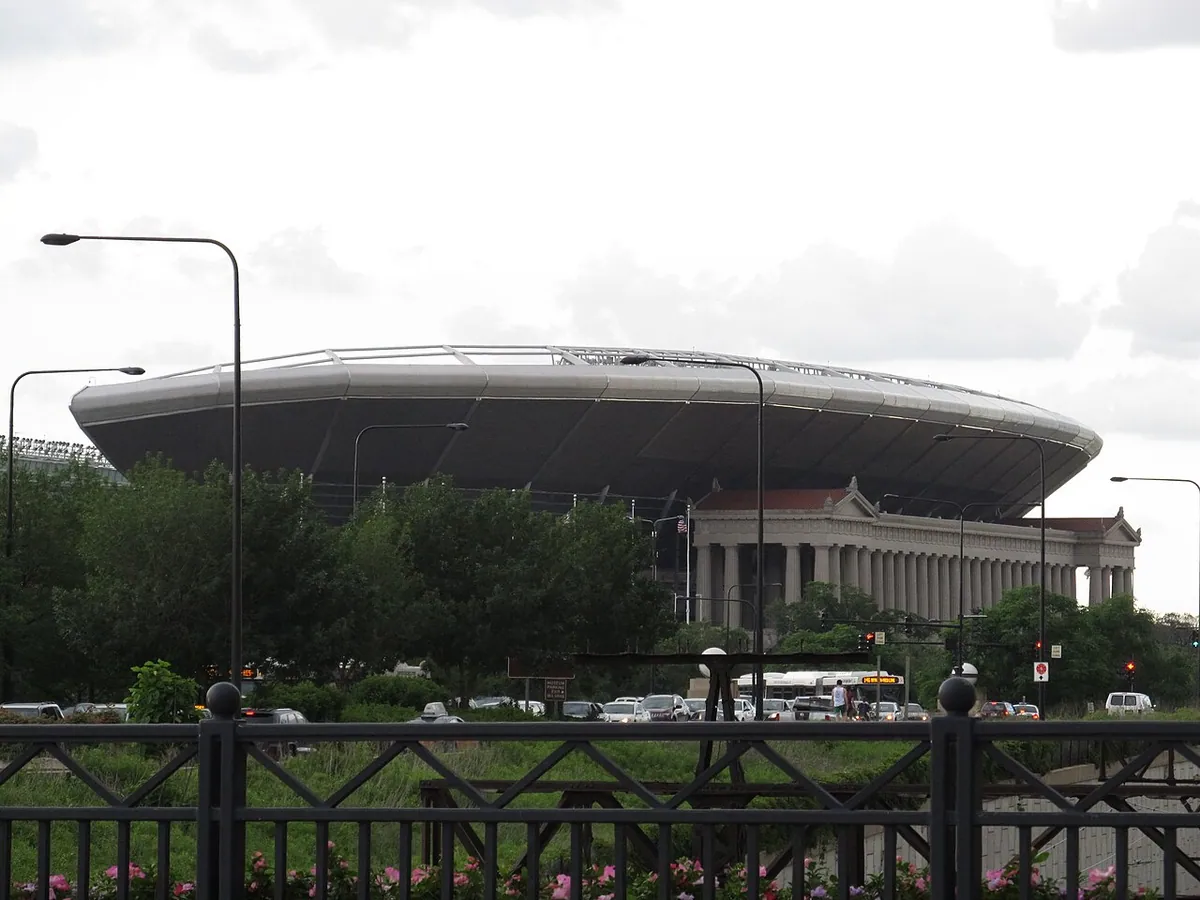
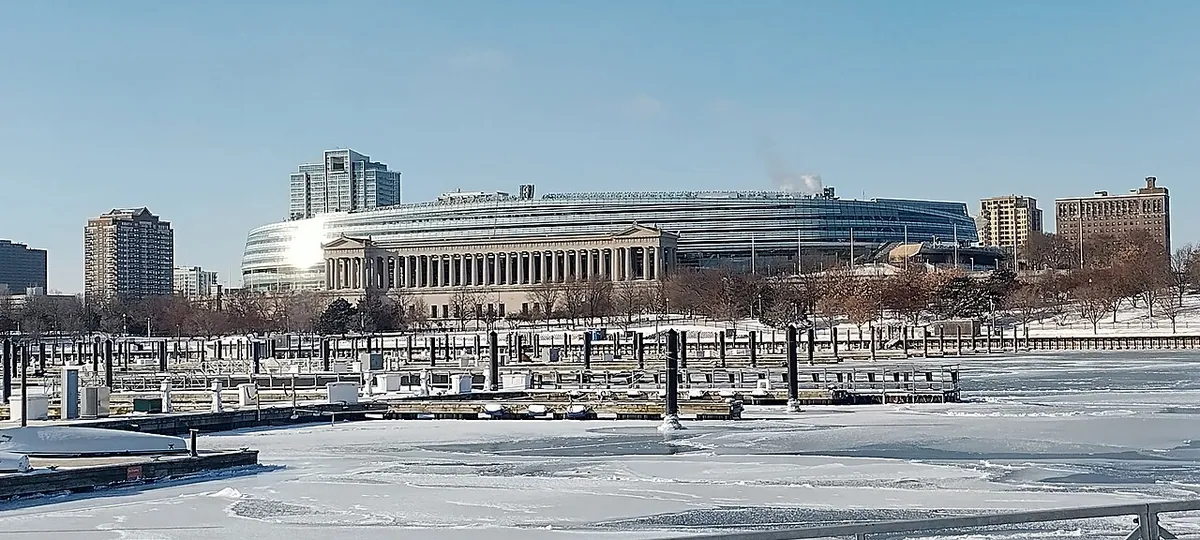
The stadium's most recognizable architectural features are the preserved colonnades and exterior walls from the original 1924 structure. The 2002 to 2003 renovation saved these elements while building a completely modern interior, an approach known as facadism. Key memorials on the grounds include the Doughboy statue at Gate O, a tribute to World War I infantrymen, and the 250-foot-long granite Memorial Water Wall honoring different branches of the armed services. The colonnades are open to the public on non-event days, and the surrounding 17-acre parkland includes a Children's Garden and hosts seasonal public events. The stadium also features a 2,500-space underground parking structure and an above-ground parking facility to the south.
Chicago Bears Tenancy and NFL History
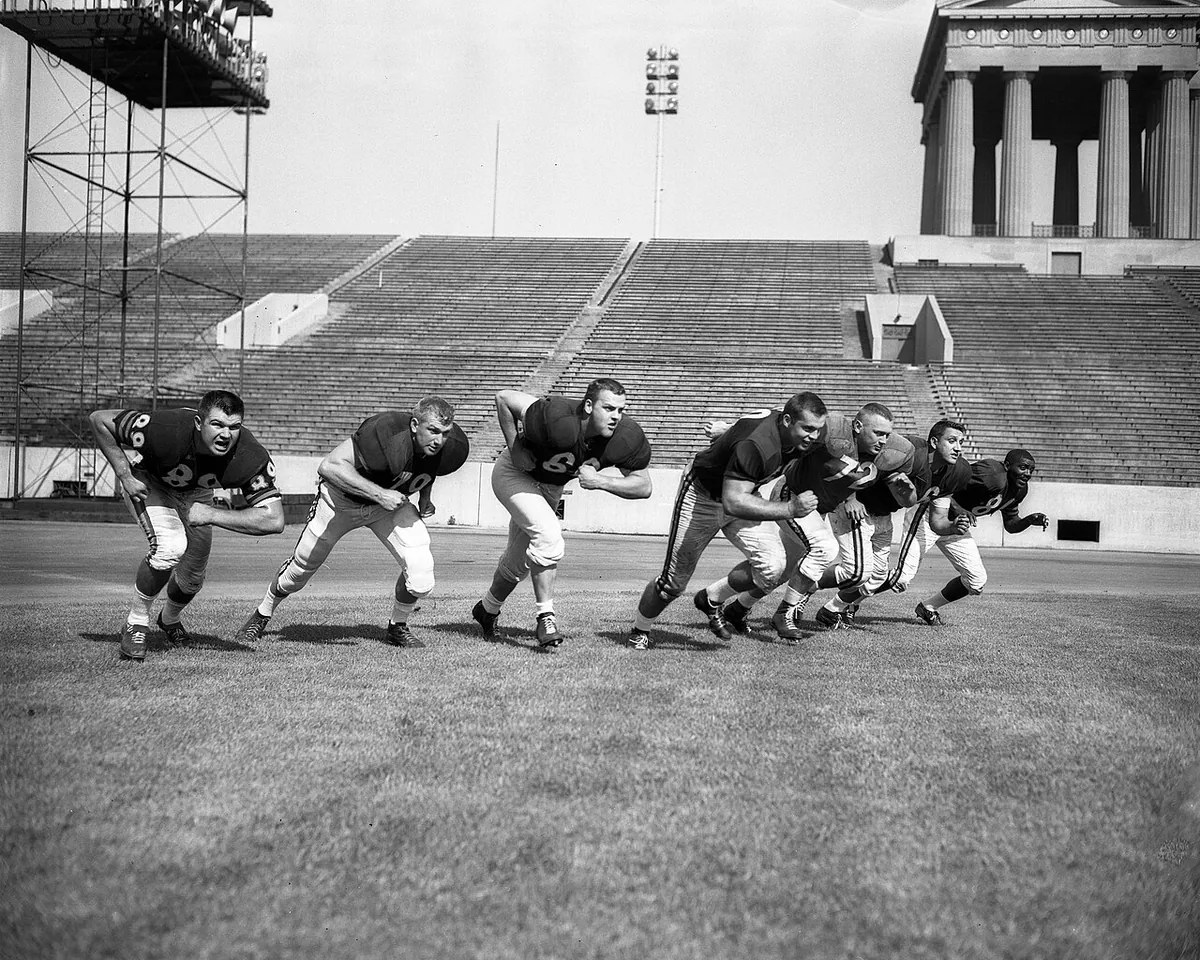
The Chicago Bears began using Soldier Field for select charity games as early as 1926 but played their primary home games at Wrigley Field. The team moved to Soldier Field full-time for the 1971 season due to post-AFL, NFL merger policies requiring stadiums to seat at least 50,000 spectators and have lighting for night games. The Bears' first regular season game at the stadium was a 17-15 victory over the Pittsburgh Steelers on September 19, 1971. In 1978, the Bears and the Chicago Park District agreed to a 20-year lease and a joint renovation of the stadium. The Bears' commitment ensured Soldier Field remained the team's home venue.
From the 1999 season through November 27, 2026, Soldier Field has hosted 224 NFL games, comprising 215 regular season contests and 9 playoff games. The Chicago Bears have been the sole home team for this entire period. The stadium has been the site of several notable playoff moments, including the 1988 NFC Divisional Playoff known as the "Fog Bowl" and the 2018 NFC Wild Card game infamously decided by a missed "Double Doink" field goal. The highest combined score in a game at Soldier Field from 1999 to 2026 was 89 points, occurring on October 19, 2008, when the Bears defeated the Minnesota Vikings 48-41. The Bears have explored relocation options over the years, including a 2021 agreement to purchase the Arlington Park property, but have remained at Soldier Field through the 2026 season.
Notable Football Games and Events
Soldier Field has a rich history of hosting landmark football games beyond Chicago Bears contests. The stadium hosted the 1926 Army, Navy Game, which decided the national championship and ended in a 21-21 tie before over 100,000 spectators. A collegiate attendance record of over 123,000 was set on November 26, 1927, for the Notre Dame vs. USC game, which the Fighting Irish won 7-6. The Chicago Cardinals of the NFL used Soldier Field as their home field for their final season in the city in 1959. The stadium has hosted the Chicago Prep Bowl, a high school championship game, including in 1937.
The University of Notre Dame has used Soldier Field for its Shamrock Series, hosting the University of Miami in 2012 and the University of Wisconsin in 2021. Soldier Field has hosted multiple NFC Championship Games. On January 21, 2007, the Bears defeated the New Orleans Saints 39-14 to advance to Super Bowl XLI. On January 23, 2011, the Bears lost to the Green Bay Packers 21-14. The stadium has never hosted a Super Bowl. Other significant playoff games include the 2025 NFC Wild Card, where the Bears beat the Green Bay Packers 31-27, and the 2025 NFC Divisional Playoff, a 20-17 overtime loss to the Los Angeles Rams.
- The 1926 Army, Navy Game, a 21-21 tie before over 100,000 fans.
- The 1927 Notre Dame vs. USC game, drawing a record crowd over 123,000.
- The 1937 Chicago Prep Bowl between Austin and Leo.
- The 1988 NFC Divisional Playoff, known as the "Fog Bowl".
- The 2006 NFC Championship Game, a Bears 39-14 win over the Saints.
- The 2010 NFC Championship Game, a Packers 21-14 win over the Bears.
- The 2018 NFC Wild Card, the "Double Doink" game.
- Notre Dame Shamrock Series games in 2012 and 2021.
The 2002 to 2003 Renovation and Controversy
The decision to renovate Soldier Field was announced in 2000 by Chicago Mayor Richard M. Daley as part of the city's Lakefront Improvement Plan. The $632 million project involved demolishing the majority of the stadium's interior while preserving the historic exterior colonnades and walls. Demolition began on January 19, 2002, immediately after the Bears' playoff loss that evening. The Bears spent the entire 2002 NFL season playing their home games at Memorial Stadium at the University of Illinois in Champaign. The new stadium was constructed in just 20 months, a record for a modern stadium project, and reopened on September 29, 2003, with a Bears loss to the Green Bay Packers.
The funding model required $432 million from taxpayers, with the Bears and the NFL contributing $200 million. The renovation was architecturally controversial, described by critics as an "Eyesore on the Lake Shore" and likened to a spaceship landing on the historic colonnades. Proponents argued the modernization was necessary due to the stadium's aging and cramped facilities. The project added state-of-the-art amenities, including two large video boards, an enlarged concourse, and the 133 luxury suites. Despite the criticism, the renovation received several awards, including an Excellence in Design award from the American Institute of Architects in 2004 and was named one of the five best new buildings of 2003 by The New York Times.
A direct consequence of the extensive alterations was the delisting of Soldier Field as a National Historic Landmark. It had received the designation on February 27, 1987. A federal advisory committee unanimously recommended delisting in September 2004, and the official removal occurred on February 17, 2006. The committee stated that keeping the landmark status would lower the standard for all National Historic Landmarks. The renovation also made Soldier Field the first NFL stadium to achieve LEED certification for environmental sustainability in May 2012.
- The Bears played the 2002 season at the University of Illinois.
- The renovation cost $632 million ($432 million from taxpayers).
- The stadium reopened on September 29, 2003.
- Soldier Field was delisted as a National Historic Landmark on February 17, 2006.
- It became the first LEED-certified NFL stadium in May 2012.
Other Tenants and Future Considerations
While the Chicago Bears are the primary tenant, Soldier Field has hosted other football and sports teams. The Chicago Fire FC of Major League Soccer moved into the stadium for the 2020 season after reaching an agreement to leave SeatGeek Stadium in Bridgeview. The stadium also hosted the 1994 FIFA World Cup and the 1999 FIFA Women's World Cup, along with multiple CONCACAF Gold Cup championships. The facility's multi-purpose nature has seen it host major concerts, rallies, and religious events throughout its history, including speeches by Franklin D. Roosevelt and Martin Luther King Jr.
The future of the Bears at Soldier Field has been a recurring topic. In June 2021, the Bears submitted a bid for the Arlington Park Racetrack property, and by September 29, 2021, they had reached a purchase agreement, signaling a serious exploration of a new stadium. In April 2024, original renovation architect Dirk Lohan released a proposal for adding a roof structure over the stadium. As of November 2026, the Bears continue to play at Soldier Field, but their long-term plans remain a subject of ongoing discussion and speculation.
- Chicago Fire FC moved to Soldier Field for the 2020 MLS season.
- Hosted the 1994 FIFA World Cup and 1999 FIFA Women's World Cup.
- Hosted speeches by Franklin D. Roosevelt and Martin Luther King Jr.
- The Bears reached a purchase agreement for Arlington Park in September 2021.
Recent games
| Date | Game | Week |
|---|---|---|
| Jan 3, 2027 | Detroit Lions at Chicago Bears | Week 17 |
| Dec 25, 2026 | Green Bay Packers at Chicago Bears | Week 16 |
| Dec 6, 2026 | Jacksonville Jaguars at Chicago Bears | Week 13 |
| Nov 22, 2026 | New Orleans Saints 13 at Chicago Bears 21 | Week 11 |
| Nov 8, 2026 | Tampa Bay Buccaneers 24 at Chicago Bears 27 | Week 9 |
| Oct 22, 2026 | New England Patriots 24 at Chicago Bears 30 | Week 7 |
| Oct 4, 2026 | New York Jets 12 at Chicago Bears 23 | Week 4 |
| Sep 28, 2026 | Philadelphia Eagles 7 at Chicago Bears 27 | Week 3 |
| Sep 20, 2026 | Minnesota Vikings 9 at Chicago Bears 3 | Week 2 |
| Jan 18, 2026 | Los Angeles Rams 20 at Chicago Bears 17 | Divisional |
| Jan 10, 2026 | Green Bay Packers 27 at Chicago Bears 31 | Wild Card |
| Jan 4, 2026 | Detroit Lions 19 at Chicago Bears 16 | Week 18 |
Video
FAQ
What is the capacity of Soldier Field?
The current football capacity of Soldier Field is 62,500 seats as configured after the 2002 to 2003 renovation. This makes it the second-smallest stadium in the NFL by seating count. Before this renovation, the capacity in 1994 was 66,944. The original stadium, opened in 1924, had 74,280 permanent seats but could accommodate over 100,000 spectators with temporary seating added for major events like the 1926 Army, Navy Game and the 1927 Notre Dame vs. USC contest.
Is Soldier Field the oldest NFL stadium?
Yes, Soldier Field is the oldest stadium in the NFL. It opened on October 9, 1924, originally named Municipal Grant Park Stadium. The Chicago Bears have played their home games there since the 1971 season. The stadium's age and historic Neoclassical colonnades contributed to its designation as a National Historic Landmark in 1987, a status it lost in 2006 following the major interior renovation that preserved the exterior facade but fundamentally changed the interior structure.
When did the Chicago Bears start playing at Soldier Field and why did they move?
The Chicago Bears began playing their home games at Soldier Field full-time starting with the 1971 NFL season. Their first regular season game there was a 17-15 win over the Pittsburgh Steelers on September 19, 1971. The team moved from Wrigley Field due to post-AFL, NFL merger league policies that required stadiums to seat at least 50,000 spectators and have lighting for potential night games. Wrigley Field, primarily a baseball park, could not meet these new NFL standards, forcing the Bears to find a larger, more modern venue.
What was the Soldier Field renovation and why was it controversial?
The Soldier Field renovation was a $632 million project from 2002 to 2003 that demolished the stadium's interior while saving the historic exterior colonnades and walls, rebuilding a completely new, modern seating bowl inside. It was controversial for both its cost, $432 million of which came from taxpayers, and its radical architectural design, which critics described as a spaceship landing on the classic structure. The renovation reduced capacity to 61,500 (later 62,500) and led to the stadium being delisted as a National Historic Landmark in 2006. Despite the controversy, it added crucial modern amenities like luxury suites, club seats, and large video boards.
Has Soldier Field ever hosted a Super Bowl or conference championship?
Soldier Field has never hosted a Super Bowl. It has, however, hosted two NFC Championship Games. On January 21, 2007, the Chicago Bears defeated the New Orleans Saints 39-14 to advance to Super Bowl XLI. On January 23, 2011, the Bears lost to the Green Bay Packers 21-14 in the NFC Championship Game. The stadium has hosted numerous other NFL playoff games, including the famous 1988 "Fog Bowl" Divisional Playoff and the 2018 "Double Doink" Wild Card game.
What other major events have been held at Soldier Field besides football?
Beyond football, Soldier Field has hosted a wide array of major events. It was a key venue for the 1994 FIFA World Cup and the 1999 FIFA Women's World Cup. The stadium was the birthplace of the Special Olympics, hosting the first World Games in 1968 and again in 1970. It has held major boxing events, including the 1927 Dempsey-Tunney heavyweight rematch. The stadium has also been the site of large political and religious rallies, with speakers such as President Franklin D. Roosevelt, Amelia Earhart, and Martin Luther King Jr. It regularly hosts major concerts and, since 2020, has been the home of MLS's Chicago Fire FC.
Sources
- Soldier Field (Wikipedia) Wikipedia
- Soldier Field in Chicago choosechicago.com
- History of Soldier Field, Illinois Sports Facilities Authority (ISFA) isfauthority.com
- Old Soldier Field, History, Photos & More of the former NFL stadium of the Chicago Bears Stadiums of Pro Football
- Soldier Field chicagoparkdistrict.com
- A Century at Soldier Field chicagohistory.org
- nflverse game, roster and draft data nflverse (CC BY 4.0)