MetLife Stadium is a multi-purpose stadium located at the Meadowlands Sports Complex in East Rutherford, New Jersey, five miles west of New York City. Opened in 2010, it replaced Giants Stadium and serves as the home for the New York Giants and New York Jets of the National Football League. With a construction cost of approximately $1.6 billion, it was the most expensive stadium in the United States at the time of its completion. The stadium has a capacity of 82,500 for football, making it the largest NFL stadium by capacity.
Location and Construction
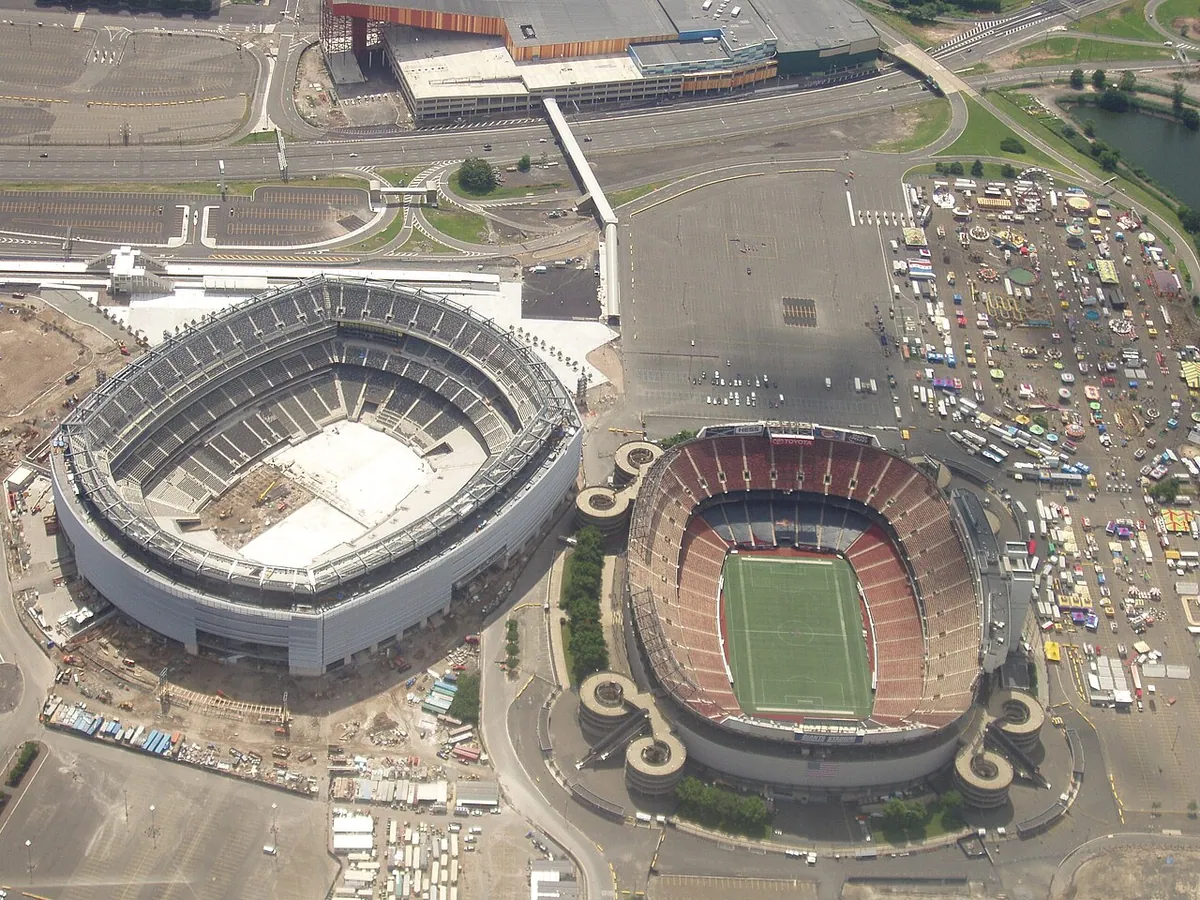
MetLife Stadium is situated at 1 MetLife Stadium Drive within the Meadowlands Sports Complex in East Rutherford, New Jersey. The stadium is located five miles west of New York City and is accessible via major highways including the New Jersey Turnpike, Route 3, and Route 120. Groundbreaking for the new stadium took place on September 5, 2007, with construction occurring from 2008 through 2010. The project was a joint venture between the New York Giants and New York Jets, who formed the New Meadowlands Stadium Company, LLC to build and operate the facility. The stadium was built to replace the aging Giants Stadium, which had been the shared home for both teams from 1984 to 2009. The total construction cost was approximately $1.6 billion, which was privately financed by the two NFL franchises and made it the most expensive stadium in the U.S. at the time of its completion in 2010.
Stadium Design and Features
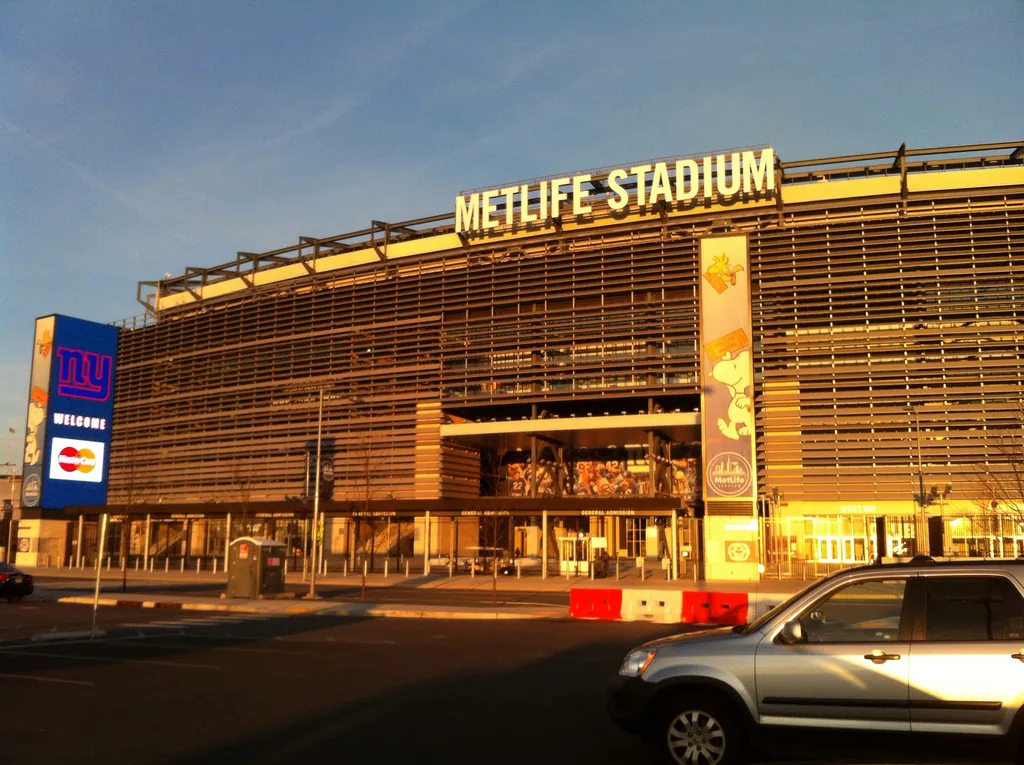
The design of MetLife Stadium was a collaboration between architectural firms 360 Architecture, EwingCole, Rockwell Group, and Bruce Mau Design, Inc. The architects aimed to create a neutral venue that could reflect the identities of both the Giants and Jets, using a facade clad in limestone-like stonework with an outer skin of aluminum louvers and glass. A key feature is the interior and exterior lighting system capable of switching colors to blue for Giants games and green for Jets games, inspired by the Allianz Arena in Munich. The stadium does not have a roof, as proposals to include one failed over funding disputes, which also prevents it from hosting certain indoor events like the NCAA Final Four. The stadium features four 30-foot by 118-foot high-definition video boards, which were upgraded in 2025 with 8MM high-resolution LED technology alongside a new stadium-wide audio system. A distinctive 'solar ring' installed in 2012 consists of 1,350 building-integrated photovoltaic panels on the upper rim, generating about 350 KW of power. The stadium contains four locker rooms, one each for the Giants and Jets and two for visiting teams, allowing for flexible use during games where both New York teams are playing. To change field decorations for the home team, crews take approximately 18 hours to remove the 40 sections that make up the teams' respective end zones. The playing surface was originally UBU Speed S5-M from 2010 to 2022 before being replaced with the FieldTurf CORE system in 2023, a multilayer dual-polymer monofilament fiber surface.
NFL Tenants and Football History
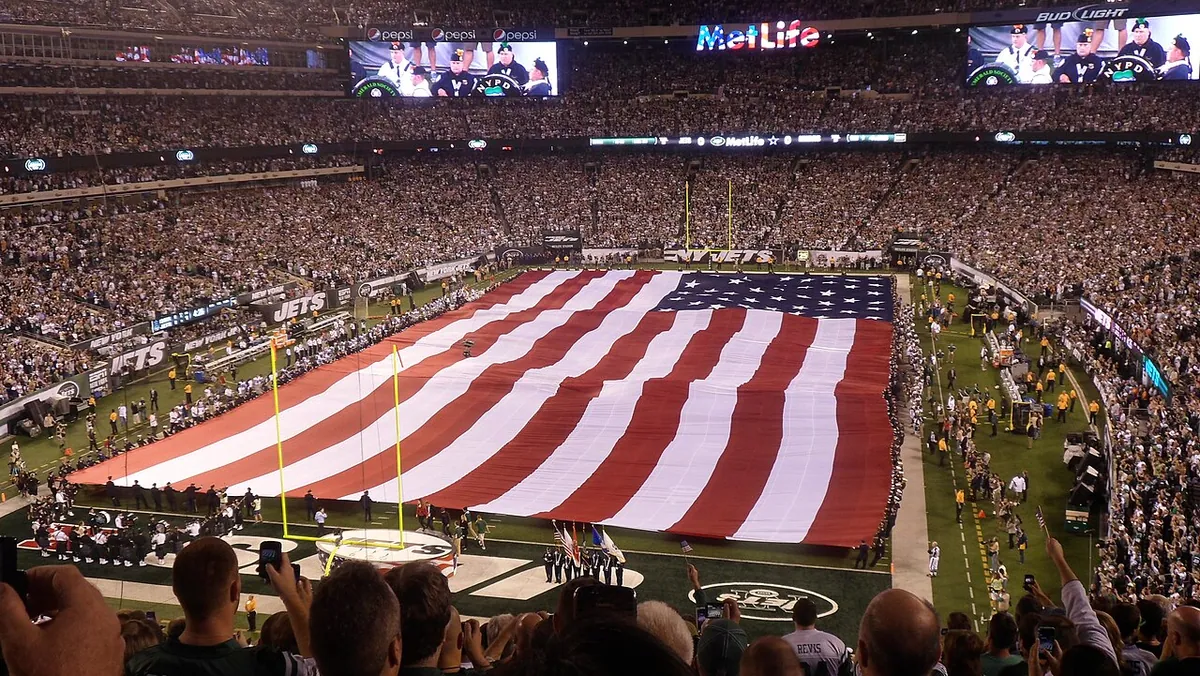
MetLife Stadium has been the home field for two National Football League franchises since its opening in 2010. The New York Giants and New York Jets are equal partners in the stadium and have both played their home games there from the 2010 season through the 2026 season. From 2010 through November 27, 2026, a total of 273 NFL games have been played at the venue, comprising 271 regular season contests and 2 playoff games. The stadium was initially known as New Meadowlands Stadium for its first two seasons before the naming rights were sold to MetLife in 2011. The Giants played their first regular season game at the stadium on September 12, 2010, defeating the Carolina Panthers 31-18. The Jets also began their tenure at the stadium that same season. The two teams meet annually in the preseason.
The stadium's shared tenancy is a historic arrangement, making it one of only two stadiums in the NFL shared by two teams, the other being SoFi Stadium in Inglewood, California. The Giants and Jets previously shared Giants Stadium from 1984 to 2009. The lease agreement with the New Jersey Sports and Exposition Authority is for a 25-year term with options to extend. The lease includes clauses allowing one team to opt out after the 15th year with proper notice, the first opportunity being in 2025. Subsequent opt-out windows occur every five years thereafter. Both teams also receive parking revenue from the Meadowlands' western parking lots year-round, regardless of stadium events.
- The New York Giants have been a tenant since the stadium opened in 2010.
- 273 NFL games were played at the stadium from 2010 through November 27, 2026.
- The stadium was originally called New Meadowlands Stadium from 2010 to 2011.
- The first opportunity for either team to opt out of the lease is in 2025, with notice required in 2024.
Super Bowls and Major Football Events
MetLife Stadium has hosted one Super Bowl, Super Bowl XLVIII at the conclusion of the 2013 NFL season. The game was played on February 2, 2014, and saw the Seattle Seahawks defeat the Denver Broncos by a score of 43-8. This event was notable as it was the first Super Bowl held in an open-air stadium in a cold-weather city. The announced attendance for the Super Bowl was 82,529, slightly above the stadium's standard football capacity. The selection of the stadium for the Super Bowl was controversial due to its lack of a roof and the potential for winter weather, but the game proceeded without significant weather issues.
Beyond the NFL, the stadium has hosted other significant football events. It was the site of the 2026 FIFA World Cup final on July 19, 2026, along with seven other tournament matches, during which it was temporarily renamed New York New Jersey Stadium. In 2025, it hosted matches of the FIFA Club World Cup, including the final. To accommodate the soccer events for the 2026 World Cup, the stadium underwent renovations from January 2024 to May 2025 to enlarge the playing field. The work involved demolishing four corners of the lower seating bowl and replacing them with a new modular steel composite seating system.
| Event | Date | Significance |
|---|---|---|
| Super Bowl XLVIII | February 2, 2014 | Seattle Seahawks 43, Denver Broncos 8 |
| 2026 FIFA World Cup Final | July 19, 2026 | Hosted tournament final, stadium renamed |
| First NFL Game | September 12, 2010 | Giants vs. Panthers (Giants win 31-18) |
| Highest-Scoring NFL Game (2010 to 2026) | December 23, 2018 | Packers 44, Jets 38 (OT), 82 combined points |
The stadium has been the site of several record-setting and notable football moments since its opening. The highest combined score in an NFL game from 2010 to 2026 occurred on December 23, 2018, when the Green Bay Packers beat the New York Jets 44-38 in overtime for a total of 82 points. Major international soccer tournaments have also left their mark, with the stadium undergoing specific renovations to meet FIFA standards. These renovations included updates to mechanical, electrical, audiovisual, and plumbing systems associated with the new seating areas. These events have solidified MetLife Stadium's reputation as a premier venue for global sports.
Capacity, Surface, and Records
For the 2026 FIFA World Cup, the capacity was configured to 80,663. The playing surface has evolved over time, starting with UBU Speed S5-M artificial turf from 2010 to 2022. In 2023, the stadium installed a new FieldTurf CORE surface, which is a dual-polymer monofilament fiber system. The stadium is an open-air venue with no roof. Several notable records and events have occurred at MetLife Stadium related to football. The stadium has faced consistent criticism from players and coaches regarding its playing surface and injury rates, with notable injuries including Aaron Rodgers' torn Achilles. Despite these concerns, NFL officials have maintained that the surface is safe.
Naming Rights and Financing
The naming rights for the stadium were secured in a 25-year deal signed on August 23, 2011, with the New York City-based insurance company MetLife. Prior to this deal, the stadium was known as New Meadowlands Stadium. The agreement followed failed negotiations with Allianz, a German financial services company, which drew protests due to the company's historical ties to Nazi Germany. The stadium's $1.6 billion construction was entirely privately financed by the Giants and Jets. The teams lease the land from the New Jersey Sports and Exposition Authority under a long-term agreement.
The joint venture structure means both teams are equal partners in the New Meadowlands Stadium Company, LLC, which operates the stadium. The lease terms include opportunities for either team to opt out after giving 12 months' notice, with the first opt-out window occurring in 2025. However, if one team leaves, the other is obligated to remain for the remainder of the lease. The teams also benefit from year-round parking revenue from the Meadowlands complex.
Transportation and Accessibility
MetLife Stadium is accessible by multiple modes of transportation, though access has been a point of criticism, particularly during major events. By car, the stadium is reachable via Exits 16W and 19W on the western spur of the New Jersey Turnpike (I-95) and is adjacent to Routes 3 and 120. Public transit options include the Meadowlands Rail Line, which operates on event days between Meadowlands station and Hoboken Terminal, with connections at Secaucus Junction to New York Penn Station and Newark Penn Station. New Jersey Transit provides the 353 Bus service for select events between the stadium and Secaucus Junction. Coach USA operates the 351 Meadowlands Express Bus between the stadium and the Port Authority Bus Terminal in Manhattan. In 2026, a dedicated bus rapid transit route called the Transitway opened from Secaucus Junction to the stadium. The stadium enforces a clear bag policy for all events, allowing only transparent bags no larger than 12”x6”x12” or small clutches measuring 4.5”x6.5”, with exceptions for medically necessary items after inspection.
Renovations and Future
MetLife Stadium has undergone significant renovations to host international soccer events. From January 2024 to May 2025, the stadium was renovated in two phases to expand the playing field to meet FIFA requirements for the 2026 World Cup. This work replaced 1,740 permanent seats with a new seating system while maintaining the NFL seating capacity and layout. These changes were necessary to accommodate the wider soccer pitch while preserving the stadium's functionality for NFL games.
Looking ahead, the stadium's future as a dual-tenancy venue appears stable despite lease opt-out clauses. The substantial private investment and the success of the shared model make relocation unlikely for either franchise. The stadium continues to be a premier venue for mega-events beyond football, having hosted WrestleMania twice and major concerts. Its selection for the 2026 FIFA World Cup final underscores its status as a world-class facility. Ongoing maintenance and potential future upgrades to the playing surface and fan amenities will likely continue as the stadium ages and technology advances.
Recent games
| Date | Game | Week |
|---|---|---|
| Jan 10, 2027 | Philadelphia Eagles at New York Giants | Week 18 |
| Jan 3, 2027 | Minnesota Vikings at New York Jets | Week 17 |
| Dec 27, 2026 | New England Patriots at New York Jets | Week 16 |
| Dec 20, 2026 | Cleveland Browns at New York Giants | Week 15 |
| Dec 13, 2026 | Denver Broncos at New York Jets | Week 14 |
| Dec 6, 2026 | San Francisco 49ers at New York Giants | Week 13 |
| Nov 22, 2026 | Jacksonville Jaguars 18 at New York Giants 23 | Week 11 |
| Nov 15, 2026 | Buffalo Bills 31 at New York Jets 12 | Week 10 |
| Nov 12, 2026 | Washington Commanders 24 at New York Giants 21 | Week 10 |
| Nov 1, 2026 | Las Vegas Raiders 38 at New York Jets 33 | Week 8 |
| Oct 25, 2026 | Miami Dolphins 28 at New York Jets 25 | Week 7 |
| Oct 18, 2026 | New Orleans Saints 34 at New York Giants 27 | Week 6 |
Video
FAQ
What NFL teams play at MetLife Stadium?
MetLife Stadium is the home field for two National Football League teams: the New York Giants and the New York Jets. Both teams have played their home games at the stadium since it opened for the 2010 NFL season. The stadium is one of only two in the NFL shared by two franchises, the other being SoFi Stadium in Inglewood, California. The Giants and Jets are equal partners in the stadium through the New Meadowlands Stadium Company, LLC. This joint venture was the first of its kind in NFL history.
When was MetLife Stadium built and how much did it cost?
MetLife Stadium was built between 2008 and 2010, with groundbreaking occurring on September 5, 2007. The stadium officially opened on April 10, 2010. The total construction cost was approximately $1.6 billion, which was entirely privately financed by the New York Giants and New York Jets. At the time of its completion, this cost made it the most expensive stadium ever built in the United States. The project was a joint venture to replace the old Giants Stadium, which had stood nearby.
Has MetLife Stadium ever hosted a Super Bowl?
Yes, MetLife Stadium hosted Super Bowl XLVIII on February 2, 2014. The Seattle Seahawks defeated the Denver Broncos by a score of 43-8 in that game. This event was historically significant as it was the first Super Bowl held in an open-air stadium in a cold-weather city. The announced attendance was 82,529, which was slightly above the stadium's standard football capacity.
Why was MetLife Stadium built without a roof?
MetLife Stadium was built without a roof because proposals to include one failed over a dispute about funding. The original plans did not include a roof due to the significant additional cost it would have incurred. This design choice means the stadium cannot host certain indoor events like the NCAA Final Four. The lack of a roof was a point of discussion when the stadium was awarded Super Bowl XLVIII. The open-air design is a defining characteristic of the venue.
What type of playing surface does MetLife Stadium have and has it been criticized?
MetLife Stadium has an artificial turf playing surface. From 2010 to 2022, the stadium used UBU Speed S5-M turf. In 2023, it was replaced with the FieldTurf CORE system, a multilayer dual-polymer monofilament fiber surface designed to be more durable and reduce player injuries. The surface has been frequently criticized by NFL players and coaches for a perceived high rate of injuries, with notable injuries including Aaron Rodgers' torn Achilles.
What is the seating capacity of MetLife Stadium?
MetLife Stadium has a seating capacity of 82,500 for NFL games and soccer matches. This makes it the largest stadium in New Jersey, the largest in the New York metropolitan area, and the largest stadium by capacity in the entire NFL. The capacity is slightly reduced to 80,663 for the 2026 FIFA World Cup due to necessary field expansions. The seating bowl includes 10,005 club seats and approximately 218 luxury suites.
Sources
- MetLife Stadium (Wikipedia) Wikipedia
- Jets 101 intro to metlife stadium nyjetsinternational.com
- MetLife Stadium: History, Capacity, Events & Significance sportsmatik.com
- New York Giants stadium: What is MetLife's capacity and how much did.. dazn.com
- Photos: Construction of MetLife Stadium giants.com
- nflverse game, roster and draft data nflverse (CC BY 4.0)