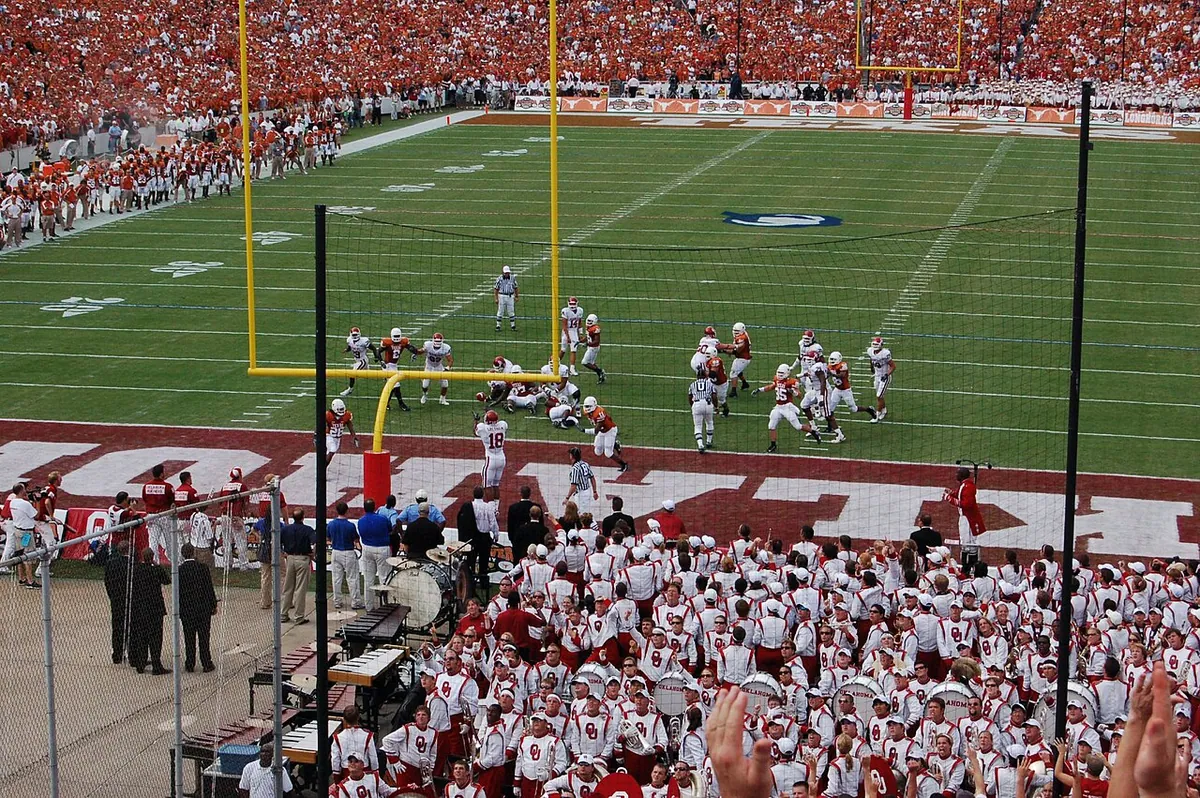
The red zone in American football is the area of the field between the opponent's 20-yard line and the goal line. It is not an officially marked zone in the rulebook but is a universally used statistical and broadcast term to denote high-probability scoring territory. The concept is used identically in NCAA football and NFL Football to analyze offensive and defensive efficiency. Coaches and analysts track red zone performance because drives that reach this area are expected to yield points. The term originated in the early 1980s and has since become a fundamental part of football strategy and fan commentary.
Definition and Field Position
The red zone is defined as the final 20 yards of the field an offense must traverse to score a touchdown, spanning from the opponent's 20-yard line to the goal line. It is a conceptual area used for statistical analysis and broadcast commentary, not a physically marked zone on the field. The direction of attack is crucial for determining red zone status a team with the ball at its own 12-yard line is not in the red zone, but a team at the opponent's 12-yard line is deep within it. This field position signifies the offense is close enough to attempt a field goal with a high degree of success for nearly all professional and college kickers. The primary objective for an offense in the red zone is to score a touchdown, while the defense aims to force a field goal attempt or a turnover. Every play within this compressed area carries extra weight, as mistakes like penalties or turnovers are more costly than on other parts of the field.
Statistical Importance and Efficiency
Red zone efficiency is a core metric for evaluating team performance, measuring the percentage of red zone trips that result in a touchdown. An offense that moves the ball well between the 20-yard lines but consistently settles for field goals in the red zone will struggle to win games. Conversely, a defense that holds opponents to field goals instead of touchdowns inside the 20 significantly improves its chances of victory. The statistic is tracked for both offense and defense in the NFL. Analysts use red zone efficiency as a stronger indicator of team quality than total yardage because it reflects a team's ability to execute under pressure in a condensed area. Teams with high red zone touchdown rates typically have disciplined, physical offenses and creative play-calling tailored to tight spaces.
Statistical analysis in the red zone focuses on several key outcomes. The touchdown conversion rate is the percentage of red zone possessions ending in a touchdown. The scoring rate measures the percentage ending in any score, including a field goal. The turnover rate tracks how often an offense gives the ball away inside the 20. Teams also analyze key outcomes in the red zone. Coaches break down these metrics further by specific field positions, such as inside the 10-yard line or inside the 5-yard line, where play-calling becomes even more critical. This data is used to install specific offensive packages and defensive strategies designed for the shortened field.
Strategic Challenges for Offense and Defense
The red zone presents unique strategic challenges because the condensed field alters the dynamics of the game. The end line acts as an extra defender for the defense, eliminating the threat of a deep pass and allowing safeties to play closer to the line of scrimmage. Offensive playbooks must adapt, as route combinations and running plays that succeeded in the open field often fail in the cramped red zone. Defensive play-calling also shifts, with an increased emphasis on press coverage, zone blitzes, and stacking the box to stop the run. The reduced space means passing windows are tighter, quarterback decisions must be quicker, and ball security is paramount because a turnover negates a near-certain scoring opportunity.
Successful red zone offenses typically employ a short, specific menu of plays rather than their entire playbook. Common strategic elements include a power running game to test defensive gap discipline, play-action passes to exploit linebackers who bite on the run fake, and quick-hitting pass concepts like slants, fades, and corner routes designed to beat tight coverage. Defenses counter by using goal-line formations with extra linemen or linebackers, playing aggressive man coverage, and disguising coverages to confuse the quarterback. The team that wins the physical battles and executes with greater precision in the red zone usually controls the game's outcome. A turnover in the red zone is worse than a punt because you gave up points you already had in hand.
History and Origin of the Term
The statistical tracking of plays inside the 20-yard line began in 1981 with Denver Broncos statistician Dave Plati, though he did not use the term red zone. Plati charted plays in this area to provide coaches with detailed analysis, a practice soon adopted by other NFL teams and the Elias Sports Bureau. The actual term red zone is widely credited to former Washington Redskins head coach Joe Gibbs. The Washington Post mentioned the phrase in an October 1981 article detailing Gibbs's focus on red zone plays during game planning. By the mid-to-late 1980s, the term had entered the common football lexicon, used by broadcasters, analysts, and fans to describe this critical scoring area.
The concept has remained consistent for over four decades, with its importance only growing as football analytics have advanced. The red zone is now a standard category in game broadcasts, with networks often selling sponsorship for red zone updates. The statistical delineation has also influenced rule changes, such as the dynamic kickoff rules introduced in the NFL in the 2020s, which require the kicker to land the ball in the red zone to avoid penalties or deep touchbacks. The Kansas Playoff method of settling ties starts play just outside the red zone, at the 25-yard line, thus most plays in that method occur in the red zone as the ball is advanced. This historical development shows how an analytical tool became a central part of the game's language and strategy.
The NFL RedZone Television Channel
NFL RedZone is a channel from NFL Network that broadcasts on Sundays during the NFL regular season from 1:00 p.m. To 8:00 p.m. Eastern Time. The channel, hosted by Scott Hanson, provides seven hours of live football coverage, showing scoring opportunities and touchdowns from every Sunday afternoon game. It brings you every touchdown from every game, acting as a fantasy football companion for viewers. The channel is available through various streaming services and TV providers, including NFL+ Premium, YouTube TV, and Sling. Its name is a direct reference to the football term, emphasizing its focus on moments when teams are in scoring position.
It is important to distinguish between the statistical concept of the red zone on the field and the NFL RedZone broadcast service. The channel does not change or influence the rules of the game but capitalizes on the excitement associated with that area of the field. NFL RedZone is described as bringing you every touchdown from every game, every Sunday afternoon during the regular season. Its success demonstrates how deeply embedded the red zone concept is in modern football culture and consumption. The channel is a special game-day exclusive that operates during the regular season.
Red Zone Rules in NFL, College, and Canadian Football
The red zone is a statistical concept, not a set of special rules, and its application is consistent across NFL and NCAA football. The field boundaries are identical, defined as the area from the opponent's 20-yard line to the goal line. The strategic importance of the red zone is the same in both leagues. In Canadian football, the concept is less emphasized due to significantly larger end zones and a wider field, which changes the spacing dynamics for offenses and defenses. The player spacing issues are less of a factor in Canadian football, where the end zones are significantly deeper and wider than in American football.
In American football, the universal understanding is that once a team crosses the 20-yard line, the probability of scoring increases dramatically, making every subsequent play critical. Coaches dedicate practice time to red zone-specific situations, installing offensive plays and defensive packages tailored to the shortened field. This consistent focus underscores that while the red zone is not an official rulebook term, it is one of the most strategically significant areas in the sport. The dynamic kickoff rule introduced in the 2020s specifically references the red zone as a target landing area for kickers, who must land the ball in the red zone without going into the end zone.
Notable Red Zone Strategies and Plays
Coaches design specific route combinations and play calls to exploit defensive weaknesses in the red zone. Common NFL passing concepts include the Smash route, with a corner route and a hitch, to stress Cover 2 defenses, and the Four Verticals or 999 concept from a 3x1 alignment to attack Cover 2 and Cover 4. Play-action passes from heavy personnel formations, like Jumbo or 23 personnel with multiple tight ends, are highly effective near the goal line as they sell a run fake to draw linebackers forward. The fade route to a tall receiver in the back corner of the end zone is a classic one-on-one solution against press coverage. Running plays often shift to downhill, power schemes like dives and leads, as lateral stretch plays have less room to develop.
| Route Concept | Primary Use | Defensive Coverage Targeted |
|---|---|---|
| Smash-7 (Corner) | Beat Cover 2 | Cover 2 |
| Four Verticals (999) | Stress safeties' depth | Cover 2, Cover 4 |
| Slant-Fade Combo | Attack press man coverage | Cover 1 (Man) |
| Play-Action 7 Route | Exploit run-focused linebackers | Goal-line zone |
Defensive strategies counter with aggressive press-man coverage, zone blitzes that bring pressure from unexpected angles, and goal-line fronts that stack eight or nine defenders near the line of scrimmage. The chess match between offensive creativity and defensive discipline inside the 20 is a defining feature of modern football strategy. Offenses will mix personnel groupings and alignments to create specific matchups in the red zone versus both zone and man coverage. Defenders in man coverage always have to prepare for the slant or fade in the deep red zone.
Related Football Terms and Concepts
Several football terms are closely associated with or used in the context of the red zone. Field goal range is a related term, as for all but the weakest amateur kickers, the red zone is universally within field goal range, assuring that points will be scored on a drive unless a turnover occurs. Ball control is a greater priority in most red zone situations because of the high likelihood of scoring. The concept is also used in commercial advertising, as radio networks have been known to sell sponsorship of the red zone whenever the home team enters it. Understanding these related terms provides a fuller picture of how the red zone fits into the broader tactical and narrative framework of a football game.
Other concepts linked to the red zone include specific offensive plans. Coaches recommend building a short red zone menu, not a new offense, with a separate list for inside the ten and inside the three. Teams should lean on their best downhill run, have one answer for man coverage, and keep a play action shot built in. Protecting the ball above everything is critical because a turnover in the red zone is worse than a punt. These concepts are used in both NCAA Football and NFL Football identically. The term finishing drives is a coaching mantra that directly relates to converting red zone opportunities into touchdowns.
Video
FAQ
What is the red zone in the NFL?
The red zone in the NFL is the area of the field from the opponent's 20-yard line to the goal line. It is a statistical and broadcast term used to denote that an offense is in high-probability scoring territory. The zone is not painted red on the field and has no special rules, but teams track their efficiency in converting red zone trips into touchdowns. This metric is a key indicator of offensive and defensive performance throughout the season.
What does red zone mean in fantasy football?
The term red zone in fantasy football discussions refers to the on-field area and is crucial for predicting player scoring. Players who get frequent targets or carries inside the 20-yard line have high touchdown potential. The NFL RedZone television channel is marketed as the perfect fantasy football companion because it shows every touchdown from every Sunday game. Tracking a player's red zone usage is a common strategy for fantasy managers when evaluating players.
How does the NFL RedZone channel work?
The NFL RedZone channel is a live broadcast that airs on Sundays during the regular season from 1:00 p.m. To 8:00 p.m. Eastern Time. Hosted by Scott Hanson, it shows scoring opportunities, touchdowns, and key moments from every Sunday afternoon game. The channel brings you every touchdown from every game, making it popular for fans who want to follow league-wide action. It is available through cable providers, streaming services, and the NFL+ Premium subscription.
Why is it called the red zone?
The term red zone was coined in the early 1980s, with former Washington Redskins coach Joe Gibbs widely credited for popularizing it. The Washington Post mentioned the phrase in an October 1981 article about Gibbs's plans to zero in on red zone plays. It originated from coaches and statisticians focusing on plays inside the 20-yard line, with the Denver Broncos' Dave Plati first tracking such plays in 1981. By the late 1980s, the term was adopted league-wide by broadcasters and the NFL's official statistician.
What is red zone efficiency?
Red zone efficiency is a statistic that measures how often a team scores a touchdown when it reaches the red zone. It is calculated by dividing the number of red zone trips ending in a touchdown by the total number of red zone trips. A high offensive red zone efficiency means a team consistently turns opportunities into seven points instead of settling for field goals. Defensive red zone efficiency measures how often a defense holds an opposing offense to a field goal or no points inside the 20.
Red zone nfl?
In the NFL, the red zone is the area of the football field between the opponent's 20-yard line and the goal line. It is a statistical and psychological term for where scoring chances are higher, not a physically red-colored area. The term has been used since the early 1980s, with former Washington Redskins coach Joe Gibbs widely credited for coining it. This concept is used identically in both NCAA Football and NFL Football.
Sources
- Red zone (gridiron football) (Wikipedia) Wikipedia
- NFL RedZone Home NFL
- What is the red zone in American football? aflepro.com
- Red Zone Offense: Scoring When the Field Shrinks fbcoachsimpson.com
- NFL Red Zone Meaning: 20-Yard Line Guide, Barcelona Restaurant & Bar barcelonalounge.com
- NFL 101: Introducing the Basic Red-Zone Route Combinations Bleacher Report